
Boundary Survey vs. Property Survey: Most Homeowners Confuse These Two
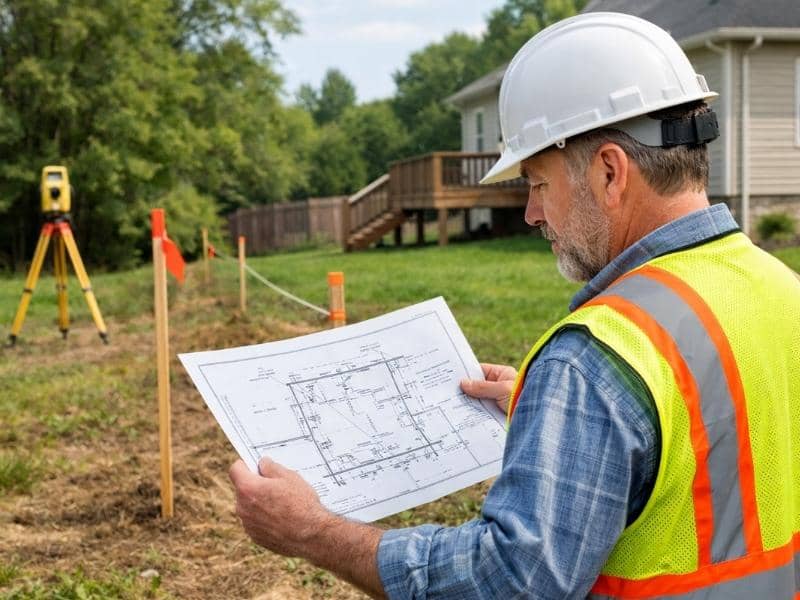
Most people use “boundary survey” and “property survey” like they mean the same thing. They do not. One is a specific type of survey with a defined process and a legal output. The other is a catch-all phrase that means different things depending on who says it.
If you are buying a home, putting up a fence, or settling a dispute with a neighbor, knowing the difference before you call a surveyor will save you time and money.
What Is a Boundary Survey?
A boundary survey is a formal survey performed by a licensed land surveyor to establish or confirm the exact legal boundaries of a piece of land. The surveyor researches deed records, plat maps, and prior surveys, then goes to the property to locate existing corner markers and measure the lines between them.
The result is a legal document, usually called a survey plat or boundary plat, that shows the property’s shape, dimensions, and corner locations. In most states, including Alabama, only a licensed land surveyor can prepare and certify this document.
What the Surveyor Actually Does on Your Property
A boundary survey is not just a quick walkthrough. The process has several steps:
- Title and records research. Before setting foot on the property, the surveyor pulls the deed, the recorded plat, and any prior surveys from the county. This gives them a starting point for what the legal description says the boundaries should be.
- Field work. The surveyor and their crew visit the property to locate existing corner monuments, iron pins, or concrete markers. They measure distances and angles between known points.
- Calculation and comparison. The field measurements are compared against the deed description. If something does not match, the surveyor investigates why.
- Setting new markers. If corner markers are missing or cannot be found, the surveyor sets new ones, typically iron rods driven into the ground.
- Drafting the plat. The final drawing shows the boundary lines, corner locations, dimensions, and any notes about discrepancies or adjoining ownership.
This process can take a few days for a simple residential lot or several weeks for a larger or more complex parcel.
What Does “Property Survey” Actually Mean?
Here is where it gets confusing. “Property survey” is not a technical term. It is a general phrase that homeowners, real estate agents, and lenders use to describe any kind of survey done on a property.
When your real estate agent says you need a “property survey,” they might mean:
- A boundary survey
- A mortgage location survey (a less detailed drawing used for closings)
- An ALTA/NSPS survey (used for commercial transactions)
- A topographic survey
The type you actually need depends on why you need it. A lender requiring a survey before closing on a house usually wants a boundary survey or a mortgage survey. A neighbor dispute almost always calls for a full boundary survey. A fence project typically needs a boundary survey too, since you need to know exactly where the line is before you start digging.
When someone says “property survey,” the safest thing to do is ask what they specifically need it for. That tells you which survey type applies.
When You Need a Boundary Survey
A boundary survey is the right choice in several common situations:
Before building a fence. Fences built on the wrong side of a property line create legal problems that can take years and thousands of dollars to resolve. A boundary survey shows you exactly where the line is before you break ground.
When a neighbor disputes the line. If a neighbor claims your driveway, shed, or landscaping crosses onto their property, a licensed boundary survey gives you a legal record of where the line actually sits. Verbal agreements and old fences do not hold up the same way.
Before a home addition or new structure. Most counties require setback compliance before issuing a building permit. A boundary survey confirms how close you can build to the property line without violating zoning rules.
Before selling or subdividing land. A clear boundary survey makes title transfer cleaner and reduces the chance of disputes during closing. If you plan to split a parcel into multiple lots, a boundary survey is the foundation for the subdivision plat that follows.
What You Get When It Is Done
When a boundary survey is complete, you typically receive:
- A signed and sealed survey plat from the licensed surveyor
- Iron pins or rods set at the property corners
- A written legal description of the boundary, if one is needed
The plat shows the property lines, dimensions, corner marker types, and the surveyor’s certification. This document can be recorded with the county and used in legal proceedings if a boundary dispute ever goes to court.
The iron pins set in the ground are called property line markers or survey monuments. They are usually iron rods about half an inch in diameter, driven flush with or just below the surface. Sometimes they are capped with a small metal disc stamped with the surveyor’s license number. These markers are the physical reference points that define your property on the ground.
What Drives the Cost of a Boundary Survey?
Boundary survey pricing is not one-size-fits-all. The final cost depends on a few specific factors that are worth understanding before you get a quote.
Parcel size. Larger lots take more time to measure and research.
Shape and terrain. An irregular lot with many corners costs more than a simple rectangle. Wooded or sloped land adds field time.
Availability of prior surveys. If a recent survey already exists for the property, the surveyor has a head start. If the deed relies on old metes and bounds descriptions with no prior survey data, more research is required.
County record accessibility. Some counties have well-organized digital records. Others require more legwork to pull the documents needed for research.
Number of missing monuments. If all four corners of your lot still have iron pins in place, the job moves faster. If the surveyor has to establish new corners from scratch, it takes more time.
Getting a written estimate upfront, along with a clear scope of what is included, is always a good idea before committing to a surveyor.
