
How Much Does a Land Survey Actually Cost in 2026?
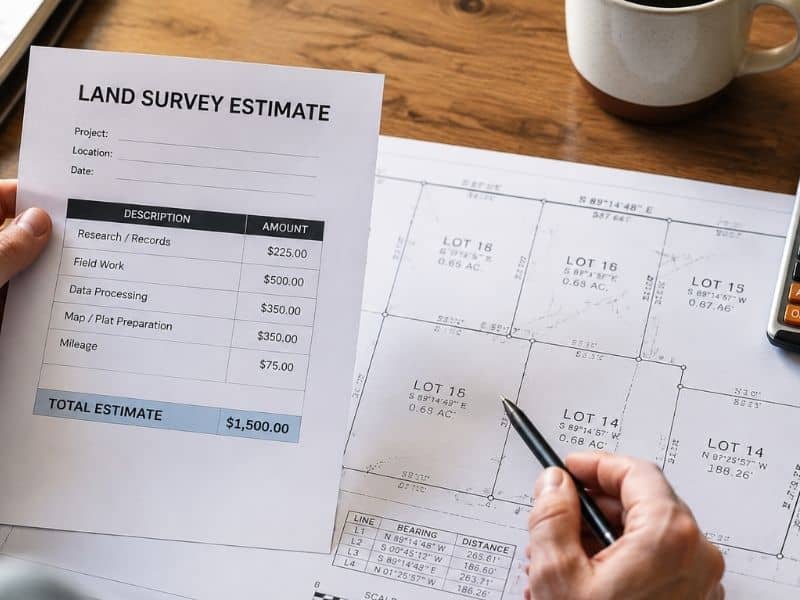
Most people have never hired a land surveyor before, so when they get a quote, they have no idea if it’s fair. Whether you’re buying a home, planning a fence, or sorting out a boundary question, this guide covers what surveys actually cost, and what affects the price.
What to Expect to Pay
In Alabama, most residential land surveys cost between $300 and $1,500 in 2026. The exact price depends on the survey type, property size, terrain, and the quality of existing records. Simple lot surveys start around $300. Boundary and topographic surveys can run higher.
The wide range exists because “land survey” covers several different services. A basic lot survey in a newer subdivision is a much simpler job than a boundary survey on a rural parcel with a 1940s deed and missing corner markers.
According to the American Land Title Association (ALTA), the national average for a residential boundary survey in 2024 was approximately $500 to $1,000, with Southeast pricing generally falling in the middle of that range.
What You’re Actually Paying For
Most people assume the cost reflects how long the surveyor spends on-site. In reality, labor and research account for roughly 60 to 70 percent of the total bill, and a lot of that work happens off the property.
Record research comes first. Before visiting your land, the surveyor pulls deed records, plat maps, and county documents, sometimes going back decades. On older or rural parcels, this alone can take several hours.
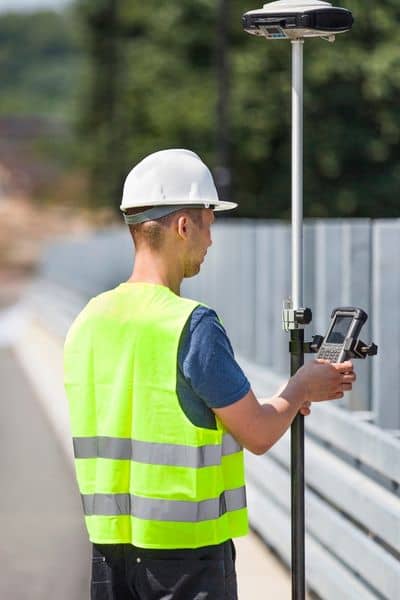
Field work is the on-site portion: measuring, locating or setting boundary monuments, and collecting data. This can take a few hours or a full day depending on the size and condition of the property.
Equipment adds to the overhead. Professional-grade GPS survey equipment costs between $20,000 and $50,000, according to industry suppliers. That investment is built into every quote you receive.
Report preparation is the final step. The surveyor processes all collected data, writes a legal description, and produces a certified plat or report that meets Alabama Board of Licensure for Professional Engineers and Land Surveyors standards.
Cost by Survey Type
Here is what each survey type typically costs.
| Survey Type | Typical Cost |
| Lot Survey | $300 to $600 |
| Property Line Survey | $300 to $700 |
| Boundary Survey | $400 to $900 |
| As-Built Survey | $500 to $1,200 |
| Elevation Certificate | $200 to $550 |
| Topographic Survey | $700 to $1,500+ |
| ALTA Survey | $1,000 to $3,000+ |
Lot survey. This confirms the dimensions and corners of a platted lot. It works best in newer subdivisions where records are already clean and well-organized.
Property line survey. Similar to a boundary survey but limited to one or two sides of a property. This is the right option when you have a question about a single shared boundary with a neighbor.
Boundary survey. The most common residential survey. It locates all four corners of your lot, marks the boundary lines, and produces a legal record of your property’s limits.
As-built survey. Done after construction is finished, this documents where buildings, utilities, and improvements were actually placed. Many local governments require one before issuing a certificate of occupancy.
Elevation certificate. This records how high your structure sits relative to the base flood elevation in your area. A large portion of Shelby County falls within FEMA-designated Special Flood Hazard Areas, so many homeowners and buyers in Chelsea need one for flood insurance purposes.
Topographic survey. A topo survey maps the physical features of a property: slopes, drainage, vegetation, and elevation changes. Builders and engineers need one before any grading or construction project begins.
ALTA survey. The most detailed and comprehensive survey type. Required by lenders and title companies on commercial transactions, ALTA surveys follow standards set jointly by the American Land Title Association and the National Society of Professional Surveyors. They cover easements, encroachments, utilities, zoning, and access rights.
What Affects the Price
Several factors push a survey above or below the typical range.
Parcel size and shape. Larger and irregular lots take more time to measure and document. Many surveyors quote larger properties by the acre or by the hour rather than a flat fee.
Condition of existing monuments. If corner markers have been removed, buried, or disturbed, the surveyor must do extra research to re-establish them. This is common on older rural properties in Shelby County.
Age and quality of deed records. Older deeds that use metes and bounds descriptions, such as references to trees or creeks, require more interpretation than modern platted lots with precise coordinates.
Terrain and vegetation. Wooded areas slow down field work and sometimes require clearing before accurate measurements can be taken. Chelsea’s semi-rural areas often have this challenge.
Turnaround time. Rush jobs are possible, but they cost more. Standard completion for a residential boundary survey runs one to three weeks from the booking date.
Prior survey history. If the property was surveyed within the last 10 to 15 years and the monuments are still in place, the job is faster and less expensive. If no prior survey exists, expect the research phase to take longer.
Is It Worth the Cost?
The median home sale price in Shelby County exceeded $350,000 in recent years, according to Alabama Center for Real Estate data. A survey that costs $500 to $800 to confirm exactly what that purchase includes is a small expense relative to the transaction.
The same math applies to improvements. Fence installation typically runs $8 to $25 per linear foot. A fence built even a few inches onto a neighbor’s property can cost far more to relocate than a survey would have cost to begin with. Boundary disputes can also lead to legal costs that dwarf the price of any survey.
What to Have Ready When You Request a Quote
A surveyor cannot give you an accurate number without knowing something about the property. Before you call, gather the following:
- The property address or parcel number
- Approximate acreage
- The reason for the survey (fence, purchase, construction, legal matter)
- Whether a prior survey was done and when
- Whether any existing monuments are visible on the property
If a firm quotes you a price without asking any of these questions, that quote is probably not reliable.
